If you have ever come across the word bequest in a will, legal document, or even a novel and wondered what it really means, you are not alone. While it may sound formal or complex, understanding the bequest meaning is actually quite simple and very useful, especially when dealing with inheritance or estate planning.
In everyday life, knowing what a bequest is can help you better understand legal terms, family inheritances, and even financial planning. This guide breaks it down in a clear, easy-to-understand way with real examples and practical explanations.
What Does Bequest Mean
Definition of Bequest
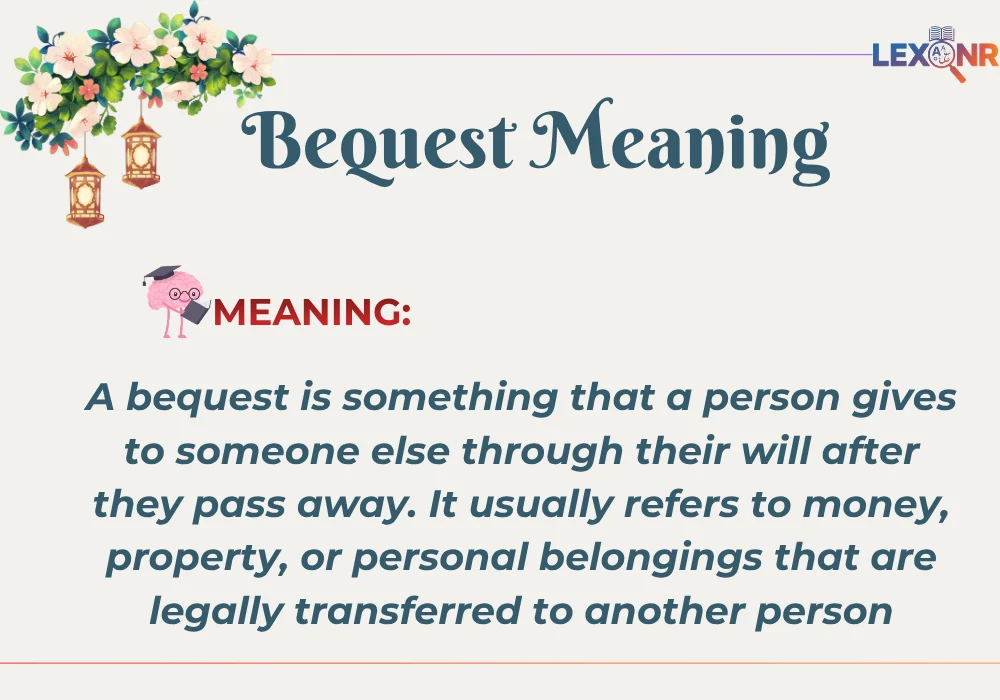
A bequest is something that a person gives to someone else through their will after they pass away. It usually refers to money, property, or personal belongings that are legally transferred to another person.
In simple words, bequest meaning is
- A gift left in a will
- Property or money given after death
- A legal transfer of assets to a beneficiary
Origin of the Word Bequest
The word bequest comes from older English legal language and has been used for centuries in wills and inheritance documents. It is closely related to the word “bequeath,” which means to leave something to someone in a will.
Over time, the term has remained important in legal and financial contexts, even though many people still find it confusing at first.
Types of Bequests
Understanding different types of bequests can make things much clearer, especially when reading a will.
Specific Bequest
This refers to a particular item or asset given to someone.
Example: A watch, a house, or a car left to a specific person
General Bequest
This is not tied to a specific item but rather a general amount or category.
Example: Leaving a certain amount of money to a person
Residuary Bequest
This includes whatever is left after all debts, taxes, and other bequests are handled.
Example: The remaining estate given to a family member
Contingent Bequest
This type depends on a condition being met.
Example: A gift given only if a certain event happens
How to Use Bequest in Real Life
In Legal Context
The word bequest is most commonly used in legal documents such as wills.
Example
He included a generous bequest to his children in his will
In Everyday Conversation
While not very common in casual talk, it can still be used when discussing inheritance.
Example
She received a bequest from her grandmother
In Writing or Literature
You may often see bequest used in books, especially in stories involving family wealth or inheritance.
Example
The old mansion was a bequest passed down for generations
Examples of Bequest in Sentences
Here are some simple examples to help you understand the bequest meaning clearly
- He left a bequest of money to his favorite charity
- Her jewelry was a bequest to her daughter
- The house became a family bequest after his passing
- She received a large bequest from a distant relative
- The will clearly mentioned each bequest and its recipient
Common Mistakes or Misunderstandings
Confusing Bequest with Gift
A bequest is different from a regular gift because it is given after death through a will.
Thinking It Only Means Money
While money is common, a bequest can include property, jewelry, or any valuable item.
Using It in the Wrong Context
The word bequest is mostly used in legal or formal situations. Using it casually can sometimes sound unnatural.
Similar Words to Bequest
| Word | Meaning | Usage Context |
|---|---|---|
| Inheritance | Property received after death | General use |
| Legacy | Something passed down | Emotional or historical context |
| Endowment | Donation, often to institutions | Educational or charitable |
| Grant | Financial award or gift | Formal or institutional |
| Donation | Gift given voluntarily | Charity or general use |
| Will | Legal document for asset distribution | Legal context |
FAQs:
What is the simple meaning of bequest
A bequest is a gift of money, property, or items given to someone through a will after a person dies.
Is bequest the same as inheritance
They are similar, but a bequest specifically refers to what is written in a will, while inheritance is the general act of receiving assets after someone passes away.
Can a bequest be anything other than money
Yes, a bequest can include property, jewelry, personal belongings, or any valuable asset.
Who receives a bequest
The person who receives a bequest is called a beneficiary.
Is bequest a legal term
Yes, bequest is mainly used in legal and financial contexts, especially in wills and estate planning.
Conclusion:
The bequest meaning is simple once you break it down. It refers to any gift or asset that is passed on to someone through a will after a person’s death. Whether it is money, property, or personal belongings, a bequest plays an important role in how assets are distributed.
Understanding this term can help you better navigate legal documents, family inheritance matters, and financial planning. It is a small word with a big impact, especially when it comes to protecting and passing on what matters most.
Have a word or term you want explained in a simple way
Share it in the comments and let us break it down together

I am John, a dedicated writer and language enthusiast with a strong interest in words and their meanings. I focus on creating clear, accurate, and easy-to-understand content to help readers strengthen their vocabulary and language skills.
Through Lexonr, my aim is to make word meanings accessible for students, learners, and language enthusiasts from all backgrounds. I believe that understanding language plays a key role in effective communication and continuous learning.
I am committed to delivering helpful, reliable, and high-quality content while contributing to the ongoing growth and improvement of Lexonr.