If you have come across the term commensalism in biology class, online articles, or nature documentaries and felt unsure about what it actually means, you are not alone. Many people confuse it with other types of relationships like mutualism or parasitism. Understanding the commensalism meaning is important because it helps explain how living organisms interact with each other in ecosystems without causing harm or benefit to one side.
This article explains commensalism in a clear, easy-to-understand way, using real-life examples, simple language, and practical explanations so you can fully grasp the concept without feeling overwhelmed.
What Does Commensalism Mean
Definition of Commensalism
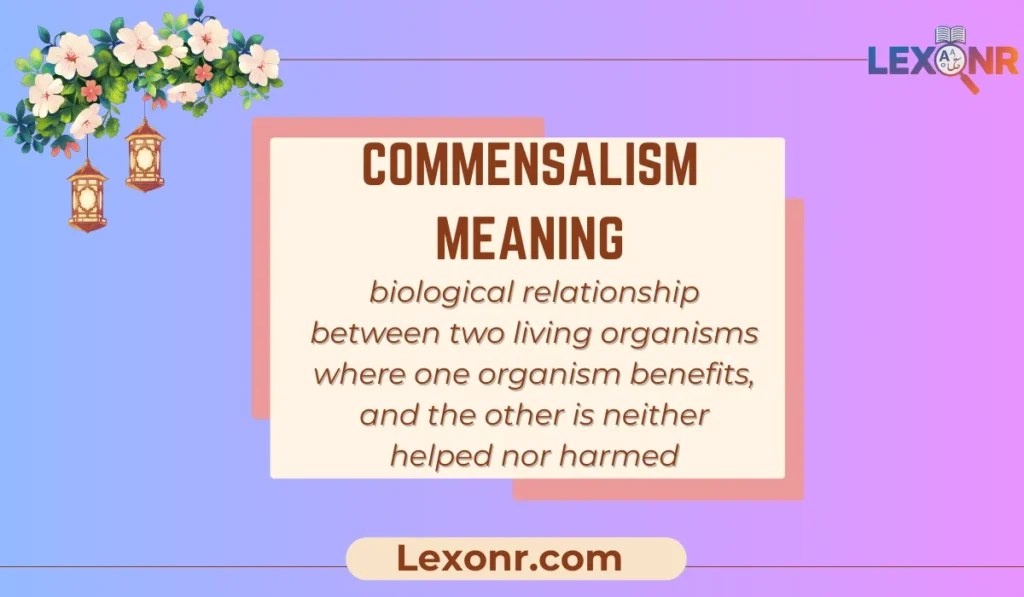
Commensalism is a type of biological relationship between two living organisms where one organism benefits, and the other is neither helped nor harmed.
In simple terms
- One organism gains something useful
- The other organism is unaffected
There is no damage, no loss, and no benefit for the second organism.
Meaning of the Word Commensalism
The word commensalism comes from Latin roots
- Com means together
- Mensa means table
Originally, it described organisms that shared food or space, where one benefitted from the presence of another without causing any impact.
How Commensalism Works in Nature
Understanding the Relationship
In commensalism, the benefiting organism may gain
- Shelter
- Transportation
- Leftover food
- Protection
The host organism continues its life normally, unaware or unaffected by the other.
This balance is what separates commensalism from other biological relationships.
Where Commensalism Commonly Occurs
Commensalism is commonly found in
- Forest ecosystems
- Oceans and coral reefs
- Grasslands
- Human environments
It exists everywhere living organisms share space.
Examples of Commensalism in Real Life
Barnacles and Whales
Barnacles attach themselves to whales and gain transportation and access to nutrient-rich waters. The whale is not harmed or helped.
Benefit: Barnacles get movement and food access
Effect on whale: No noticeable impact
Birds Nesting in Trees
Birds build nests in trees for shelter and safety.
Benefit: Birds gain a home
Effect on tree: Tree remains unaffected
Remora Fish and Sharks
Remora fish attach to sharks and eat leftover food.
Benefit: Remora gets food and protection
Effect on shark: No benefit or harm
Bacteria on Human Skin
Certain harmless bacteria live on human skin and gain nutrients.
Benefit: Bacteria survive
Effect on humans: Neutral impact
How Commensalism Is Different From Other Relationships
Understanding commensalism meaning becomes easier when compared with other symbiotic relationships.
Commensalism vs Mutualism
- Commensalism: One benefits, other unaffected
- Mutualism: Both organisms benefit
Example of mutualism: Bees and flowers
Commensalism vs Parasitism
- Commensalism: No harm done
- Parasitism: One benefits, the other is harmed
Example of parasitism: Ticks feeding on animals
Commensalism vs Amensalism
- Commensalism: One benefits, one unaffected
- Amensalism: One is harmed, one unaffected
Similar Biological Relationships
| Relationship Type | Meaning | Effect on Organisms |
|---|---|---|
| Mutualism | Both organisms benefit | Positive and positive |
| Parasitism | One benefits, one is harmed | Positive and negative |
| Amensalism | One harmed, one unaffected | Negative and neutral |
| Competition | Both compete for resources | Negative and negative |
| Neutralism | No effect on either | Neutral and neutral |
This table helps clearly show where commensalism fits among ecological interactions.
Why Commensalism Is Important in Ecosystems
Commensalism plays a major role in maintaining balance within ecosystems.
It helps by
- Supporting biodiversity
- Allowing species to survive without conflict
- Encouraging coexistence
- Reducing competition
Many organisms rely on commensal relationships to survive in challenging environments.
Common Misunderstandings About Commensalism
Thinking One Organism Is Always Helped Actively
In commensalism, the host organism usually does nothing intentionally. The benefit happens passively.
Confusing It With Mutualism
If both organisms benefit, it is not commensalism.
Assuming the Relationship Is Permanent
Some commensal relationships are temporary and change over time depending on conditions.
FAQs:
What is the simplest definition of commensalism
Commensalism is a relationship where one organism benefits and the other is unaffected.
Is commensalism harmful
No. The host organism is neither harmed nor helped.
Can commensalism change into another relationship
Yes. Over time, it can shift into mutualism or parasitism depending on environmental changes.
Is commensalism common in nature
Yes. It is very common across plants, animals, and microorganisms.
Do humans experience commensalism
Yes. Certain bacteria living on human skin are examples of commensalism.
Conclusion:
The commensalism meaning describes a natural relationship where one organism benefits while the other remains unaffected. It is a key concept in biology that helps explain how different species coexist without conflict or dependence.
By understanding commensalism, it becomes easier to see how ecosystems stay balanced and why not all interactions in nature involve competition or harm. This concept highlights how simple coexistence can play a powerful role in sustaining life.

I am John, a dedicated writer and language enthusiast with a strong interest in words and their meanings. I focus on creating clear, accurate, and easy-to-understand content to help readers strengthen their vocabulary and language skills.
Through Lexonr, my aim is to make word meanings accessible for students, learners, and language enthusiasts from all backgrounds. I believe that understanding language plays a key role in effective communication and continuous learning.
I am committed to delivering helpful, reliable, and high-quality content while contributing to the ongoing growth and improvement of Lexonr.