If you’ve come across the word itinerant in a conversation, text, or even social media post and felt puzzled, you’re not alone. While it sounds formal, understanding itinerant meaning can actually help you grasp subtle contexts in both everyday language and online discussions.
Knowing this term helps you communicate clearly, avoid misunderstandings, and even sound a bit more sophisticated while chatting or writing online.
What Does Itinerant Mean
Definition of Itinerant
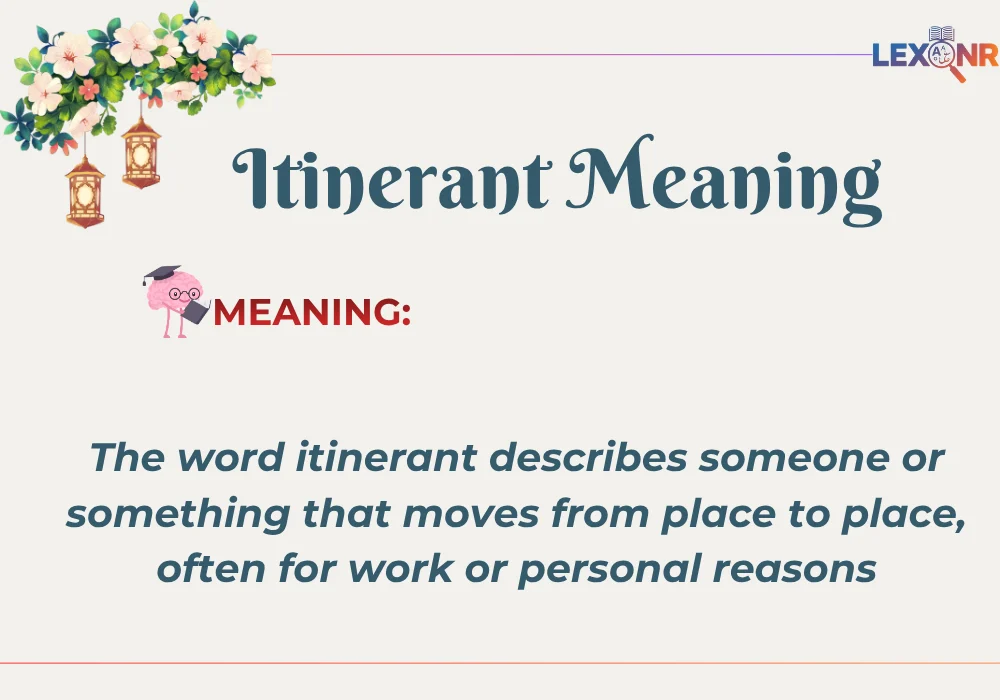
The word itinerant describes someone or something that moves from place to place, often for work or personal reasons. In simpler terms, it refers to:
- People who travel regularly rather than staying in one location
- Workers or professionals who move to different job sites
- Anything that is temporary, mobile, or not fixed
In casual texting or conversation, using itinerant can describe people who travel frequently or lifestyles that are not tied to one location.
Origin of Itinerant
The term comes from the Latin word itinerare, meaning to travel. Traditionally, it was used for traveling workers like teachers, priests, or merchants who moved between locations for work.
Online, it has retained its core meaning but is often used to describe lifestyles, travel habits, or even digital nomads who are constantly on the move.
How to Use Itinerant in Texts or Chat
When Itinerant Is Appropriate
Itinerant works best in contexts like:
- Describing jobs or work patterns
- Talking about frequent travel
- Social media captions or posts about travel
- Informal discussion about moving or relocating
It is more formal than slang like “wanderer,” but it can still fit casual conversations if used naturally.
Common Ways People Use Itinerant
Describing a job or role
Example: My cousin is an itinerant teacher, so she teaches at different schools each week
Talking about travel lifestyle
Example: I love my itinerant lifestyle, always exploring new cities
Referring to temporary situations
Example: The exhibit is itinerant, moving to a new museum next month
Examples of Itinerant in Conversations
Texting example
Friend one: How is your cousin’s work going?
Friend two: She’s still itinerant, teaching at a different school every week
Social media example
Just finished another week on the road. Loving this itinerant life
Group chat example
Do not worry, the itinerant market will be back in town next weekend
These examples show how itinerant can describe movement, temporary setups, or traveling lifestyles.
Common Mistakes or Misunderstandings
Using Itinerant to Mean Permanent
Itinerant always implies movement or temporary status. Using it for something fixed is incorrect.
Better: She is an itinerant teacher
Incorrect: She is an itinerant teacher at the same school for years
Using Itinerant Too Casually
While it can fit casual contexts, itinerant sounds more formal than slang. Avoid overusing it in informal chat unless it feels natural.
Confusing It with Wandering
Itinerant implies purpose (work, duty, assignment). Wandering implies aimlessness.
Similar Words and Related Terms
| Term | Meaning | Common Usage |
|---|---|---|
| Nomadic | Moving frequently, often by choice | Travel, lifestyle |
| Roaming | Moving from place to place | Travel, phones, online chats |
| Wandering | Moving without fixed direction | Casual conversation |
| Mobile | Able to move easily | Jobs, tech, travel |
| Peripatetic | Traveling especially for work | Formal writing, education |
| Migratory | Moving seasonally or periodically | Nature, work |
| Transient | Temporary, not permanent | Housing, work, lifestyle |
These words can overlap with itinerant depending on context, tone, and audience.
FAQs:
What does itinerant mean in simple words
Itinerant means moving from place to place, often for work or temporary reasons.
Can itinerant describe a person
Yes, it commonly describes people like traveling workers, teachers, or performers.
Is itinerant a positive or negative term
It is neutral, describing a lifestyle or work style without judgment.
Can itinerant be used casually
Yes, but it sounds slightly formal. Use it naturally in conversation about travel or jobs.
Is itinerant the same as nomadic
Similar, but itinerant usually implies movement for work or purpose, while nomadic can be lifestyle-based or personal choice.
Conclusion:
The itinerant meaning revolves around movement, temporary situations, and traveling for work or personal reasons. It is a useful word to describe lifestyles, jobs, and temporary setups clearly and precisely.
Understanding itinerant helps you communicate effectively in both casual chats and more formal contexts. Use it naturally to describe people, experiences, or situations that are constantly on the move, and your language will feel both accurate and engaging.
Have you ever had an itinerant job or lifestyle? Share your experience in the comments and let’s talk about the ups and downs of life on the move

I am John, a dedicated writer and language enthusiast with a strong interest in words and their meanings. I focus on creating clear, accurate, and easy-to-understand content to help readers strengthen their vocabulary and language skills.
Through Lexonr, my aim is to make word meanings accessible for students, learners, and language enthusiasts from all backgrounds. I believe that understanding language plays a key role in effective communication and continuous learning.
I am committed to delivering helpful, reliable, and high-quality content while contributing to the ongoing growth and improvement of Lexonr.