If you’ve ever seen someone say deflect in a text, comment, or chat and wondered what they meant, you’re not alone. In modern online conversations, deflect meaning has expanded beyond its traditional dictionary definition and now plays an important role in how people communicate online. Understanding this term helps you avoid misunderstandings, respond appropriately, and stay in tune with digital communication trends.
This guide explains what deflect means in texting and online slang, how people use it in real conversations, and how you can apply it naturally in your own messages.
What Does Deflect Mean in Slang
Definition of Deflect in Texting
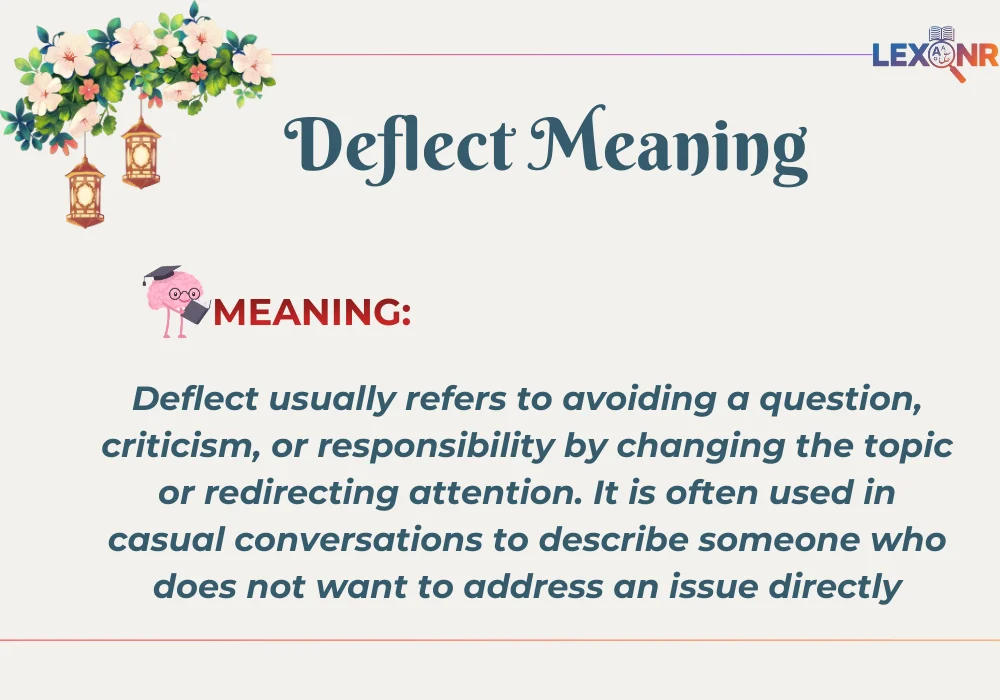
In internet slang, deflect usually refers to avoiding a question, criticism, or responsibility by changing the topic or redirecting attention. It is often used in casual conversations to describe someone who does not want to address an issue directly.
In simple terms, to deflect means:
- To dodge accountability
- To shift focus away from yourself
- To respond in a way that avoids addressing the main point
The meaning depends heavily on context, tone, and who is speaking.
Origin of Deflect as Slang
Traditionally, deflect means to turn aside or redirect. Online, it evolved into a slang term to describe conversations where someone avoids confrontation or awkwardness.
Social media, memes, and texting culture contributed to this evolution, making it a commonly recognized term among younger internet users. It is often used in a playful or sarcastic way, though it can also be pointed when calling out avoidance.
How to Use Deflect in Texts or Chat
When Deflect Is Appropriate
Deflect works best in casual and informal settings, such as:
- Texting with friends
- Group chats
- Social media comments
- Online discussions
It is not suitable for professional or serious conversations.
Common Ways People Use Deflect
Playful teasing
Used when someone tries to avoid responsibility humorously
Example: You totally ate the last slice of pizza and just said it wasn’t you, classic deflect
Calling out avoidance
Used when someone changes the topic instead of answering
Example: Stop deflecting, I know you didn’t finish your homework
Self-aware humor
People use it jokingly to describe their own behavior
Example: Me when someone asks why I’m late: oh, I was busy… okay, deflect moment
Using it on yourself is safe and relatable.
Examples of Deflect in Conversations
Texting example
Friend one: Did you finish your chores yet
Friend two: Well, I saw the cutest dog outside, haha deflect
Social media example
Me trying not to answer my boss’s email immediately, full deflect energy
Group chat example
Friend one: Why are you always late
Friend two: I mean… traffic? Kind of deflecting but accurate
Gaming chat example
Stop deflecting the blame for losing that round
These examples show that deflect can be humorous, sarcastic, or even slightly accusatory, depending on context.
Common Mistakes or Misunderstandings
Using Deflect Too Seriously
Deflect is mostly playful or sarcastic. Using it as a serious critique can make the conversation awkward.
Better: That was a deflect moment
Risky: You always deflect everything
Using Deflect in Formal Settings
Since it is slang, deflect should stay in casual or personal communication. Avoid it in work emails or professional conversations.
Assuming Everyone Understands It
Not everyone follows online slang. If someone looks confused, it’s better to clarify or explain lightly.
Similar Slangs to Deflect
| Slang Term | Meaning | Common Usage |
|---|---|---|
| Dodge | Avoid responsibility or question | Casual texting, memes |
| Side-step | Change topic to avoid confrontation | Group chats, online forums |
| Shift blame | Pass responsibility to someone else | Gaming, social media |
| Brush off | Ignore or downplay criticism | Texting, memes |
| Pivot | Redirect attention quickly | Social media, conversations |
| Gaslight | Manipulate to avoid accountability | Online discussions, critiques |
| Pass the buck | Avoid responsibility by giving it to someone else | Casual or humorous conversations |
These slang terms overlap with deflect in casual conversation and humor.
FAQs:
What does deflect mean in texting
In texting, deflect means to avoid answering a question or taking responsibility by redirecting the focus elsewhere.
Is deflect an insult
Not necessarily. It can be playful, sarcastic, or teasing, though it can sometimes highlight avoidance in a critical way.
Can I call myself deflecting
Yes. People often use deflect on themselves to describe playful or humorous avoidance.
Is deflect used only online
No. While popular online, it can also be used in casual face-to-face conversations.
Is deflect safe to use with friends
Yes. It is best used with friends or people who understand internet slang. Avoid using it with strangers or in professional settings.
Conclusion:
The deflect meaning in texting and online slang revolves around humor, avoidance, and subtle sarcasm. It is used to describe situations where someone dodges questions, responsibilities, or awkward moments.
As with all slang, tone and context matter. Using deflect among friends or in casual conversations adds personality and relatability. Using it on yourself is a safe and humorous way to join in on the trend.
Have a favorite slang word or abbreviation you often see online
Share it in the comments and let’s break it down together

Hi I am Mark Alex , a dedicated writer and language enthusiast with a strong passion for words and their meanings. I focus on creating clear, accurate, and easy-to-understand content to help readers improve their vocabulary and language skills.
Through Lexonr, my goal is to make word meanings accessible for students, learners, and language lovers from all backgrounds. I believe that understanding words is the foundation of effective communication and lifelong learning.
I am committed to providing helpful and reliable content while continuously improving the quality and usefulness of Lexonr.