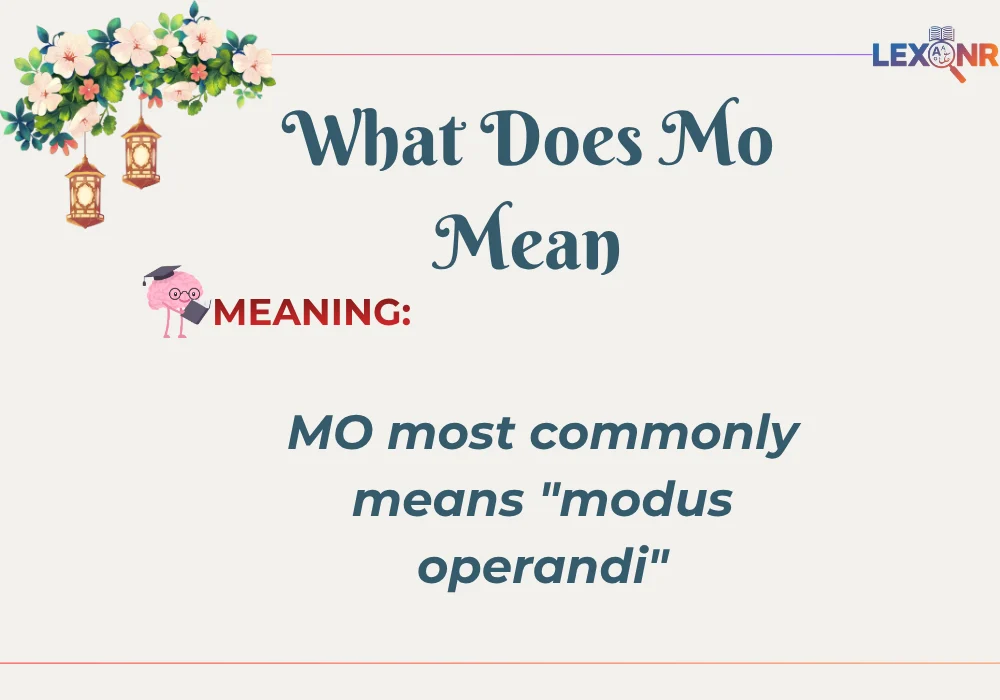
If you’ve seen “MO” in a text message, social media post, or online chat, you may be wondering what it means. The abbreviation “MO” can have several meanings depending on the context, but it most commonly stands for “modus operandi” or someone’s usual way of doing things.
People often encounter this term on TikTok, Snapchat, Instagram, WhatsApp, and in text conversations. Since abbreviations can have different meanings online, many users search for “MO meaning” to understand exactly what someone is trying to say.
The good news is that MO is usually easy to understand once you know the context of the conversation.
Mo Meaning in Text
In texting and online conversations, MO most commonly means “modus operandi.
This Latin phrase translates to “method of operation” or “usual way of doing something.”
People use MO when talking about someone’s habits, behavior, or typical actions.
For example:
- “Staying up late is his MO.”
- “That’s her MO whenever she’s upset.”
- “Ignoring messages for hours is kind of his MO.”
Is MO Slang or an Abbreviation?
MO is an abbreviation rather than traditional internet slang.
While it originated from the phrase “modus operandi,” it has become common in casual conversations, social media discussions, and texting.
Many people use it without even knowing its Latin origin.
What Does MO Mean in Everyday Chat?
In everyday conversations, MO usually refers to:
- A person’s habits
- Their usual behavior
- A common pattern of actions
- Their typical approach to situations
Examples:
- “Being early is her MO.”
- “Making jokes during meetings is his MO.”
- “That’s just my MO when I’m nervous.”
Where People Use Mo
TikTok
On TikTok, users often use MO when discussing someone’s behavior or personality.
Examples:
- “Being dramatic is her MO.”
- “That’s literally his MO every time.”
Snapchat
Snapchat users may use MO in private chats with friends.
Examples:
- “Ghosting people is not my MO.”
- “That’s been her MO for years.”
On Instagram, MO appears in comments, captions, and direct messages.
Examples:
- “Posting vacation pictures daily is his MO.”
- “That’s always been her MO.”
WhatsApp group chats frequently include MO when discussing habits or recurring actions.
Examples:
- “Being late is his MO.”
- “That’s our MO when planning trips.”
SMS
In text messages, MO helps describe someone’s usual behavior quickly.
Examples:
- “Helping everyone is her MO.”
- “That’s not really my MO.”
Real Chat Examples
Example 1
A: Why didn’t Jake answer?
B: Honestly, that’s his MO.
A: Makes sense.
Example 2
A: Sarah always arrives early.
B: Yeah, that’s her MO.
A: She’s super organized.
Example 3
A: Why is he making jokes again?
B: That’s basically his MO.
A: True.
Example 4
A: She changed her mind again.
B: That’s her MO.
A: I should’ve expected it.
Example 5
A: Why does he keep buying gadgets?
B: That’s his MO.
A: He loves technology.
Example 6
A: She volunteers every weekend.
B: Helping people is her MO.
A: That’s awesome.
Example 7
A: He always takes the safe option.
B: That’s his MO.
A: Nothing wrong with that.
Example 8
A: Why is she double-checking everything?
B: That’s her MO.
A: She’s very careful.
Example 9
A: He always waits until the last minute.
B: That’s his MO.
A: Stressful way to live.
Example 10
A: Why did she bring snacks?
B: That’s her MO.
A: She always thinks ahead.
How to Reply When Someone Says “Mo”
Your response depends on the conversation.
Funny Replies
- “Sounds about right.”
- “Classic behavior.”
- “Some things never change.”
Casual Replies
- “True.”
- “I agree.”
- “Good point.”
- “That’s fair.”
Friendly Replies
- “That’s what makes them unique.”
- “I can definitely see that.”
- “You’re probably right.”
Neutral Replies
- “Interesting observation.”
- “That makes sense.”
- “I hadn’t thought about it that way.”
Is Mo Rude or Offensive?
No, MO is generally not rude or offensive.
It is simply a way to describe someone’s usual behavior or habits.
However, the tone of the sentence matters.
For example:
- “Helping people is her MO.”
This sounds positive.
But:
- “Lying is his MO.”
This sounds negative because of the statement itself, not because of the abbreviation.
Is It Safe to Use?
Yes, MO is safe for:
- Text messages
- Social media
- Group chats
- Casual conversations
- Online discussions
Is It Appropriate at School or Work?
Yes. MO is commonly understood and generally acceptable in school and workplace conversations.
For formal writing, however, it may be better to write out “modus operandi” or “usual method.”
Who Uses This Term?
Age Groups
MO is used by:
- Teenagers
- Young adults
- Adults
- Professionals
Unlike some internet slang, MO is common across multiple generations.
Gen Z Usage
Gen Z users occasionally use MO, especially in social media discussions and texting.
However, it is also widely used by Millennials and older adults.
Common Platforms
You may see MO on:
- TikTok
- Snapchat
- X
- SMS
How Often Does It Appear Online?
MO is fairly common online, especially when discussing behavior, habits, or personality traits.
Origin of the Term
MO comes from the Latin phrase “modus operandi.”
The phrase originally referred to a person’s method of working or operating.
It became widely known through law enforcement and crime investigations, where investigators used it to describe a criminal’s typical pattern of behavior.
Over time, the term moved into everyday language and became a casual way to describe anyone’s usual habits or actions.
Internet Culture and MO
As online communication evolved, people shortened longer phrases into abbreviations.
MO became popular because:
- It’s short
- It’s easy to type
- It clearly describes habits
- It’s widely understood
Today, many users employ it without knowing its historical background.
Comparison Table
| Term | Meaning | Type | Usage | Popularity |
|---|---|---|---|---|
| MO | Modus Operandi | Abbreviation | Describing habits or behavior | High |
| IDK | I Don’t Know | Acronym | Expressing uncertainty | Very High |
| IDC | I Don’t Care | Acronym | Showing indifference | Very High |
| IMO | In My Opinion | Acronym | Sharing opinions | Very High |
| BRB | Be Right Back | Acronym | Temporary absence | High |
Real World Usage Example
Imagine you’re talking with a friend about a coworker who always arrives at meetings ten minutes early.
Your friend says:
“Showing up early is basically her MO.”
In this situation, MO means that arriving early is her usual habit or typical behavior.
The abbreviation helps communicate that idea quickly and naturally.
FAQs:
What does MO mean in text messages?
MO usually stands for “modus operandi,” meaning a person’s typical behavior, habit, or way of doing things.
What does MO mean on TikTok?
On TikTok, MO often refers to someone’s usual actions or personality traits.
Is MO slang?
MO is an abbreviation rather than traditional slang, though it is commonly used in casual online conversations.
Is MO rude or offensive?
No. MO itself is not rude or offensive. The tone depends on the surrounding message.
How should you reply to MO?
You can respond with agreement, ask for clarification, or comment on the behavior being discussed.
Conclusion:
MO most commonly means “modus operandi,” which refers to a person’s usual behavior, habits, or way of doing things. You’ll often see it in text messages, social media comments, and casual online discussions.
The abbreviation is generally safe, friendly, and easy to use in everyday conversations. Understanding MO can help you follow online chats more easily and communicate more naturally when discussing someone’s typical actions.

Hi, I’m Mike Grobgaard, founder of Lexonr. I write about meanings, internet slang, biblical terms, and modern expressions in a simple yet engaging way. My goal is to help readers understand the deeper story behind every word they search for.