You may have seen or heard the word exploitation in news articles, social media discussions, school lessons, or serious online conversations. Many people use the term, but not everyone fully understands what it means or how it applies in real life. Knowing the exploitation meaning is important because it helps you recognize unfair treatment, abuse of power, and situations where someone is being taken advantage of.
In this article, we will clearly explain the meaning of exploitation, how it is used in different contexts, real-life examples, common misunderstandings, and related terms. Everything is written in easy language so it is simple to understand and practical to use.
What Does Exploitation Mean
Definition of Exploitation
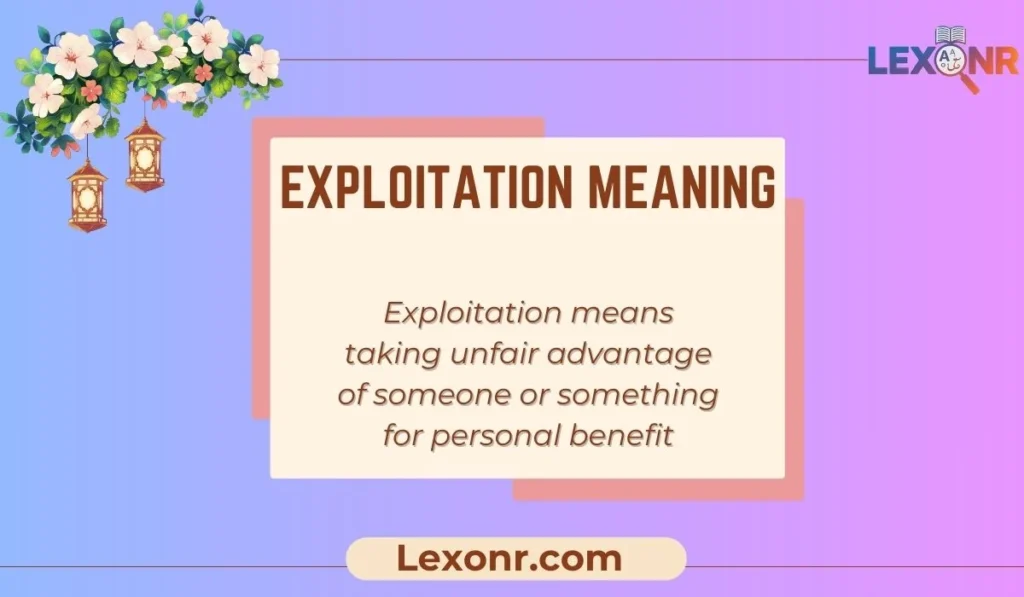
Exploitation means taking unfair advantage of someone or something for personal benefit. This usually happens when one side has more power, control, or resources than the other.
In simple terms, exploitation is when
- Someone benefits while another person is harmed or treated unfairly
- A situation involves misuse of power, trust, or vulnerability
- One party gains at the expense of another
Exploitation can happen to people, workers, communities, animals, or natural resources.
Origin of the Word Exploitation
The word exploitation comes from older language roots meaning to make use of or to utilize. Over time, the meaning shifted from neutral use to a negative one, especially when referring to unfair or harmful use.
Today, exploitation almost always carries a negative meaning and is associated with injustice, abuse, or unethical behavior.
Exploitation meaning in biology
In biology, exploitation refers to a relationship where one organism benefits while another is harmed or disadvantaged. It commonly appears in ecological interactions such as predation, parasitism, or herbivory.
Examples of exploitation in biology
- Parasitism → A parasite benefits while harming the host
- Predation → One animal hunts and consumes another
- Herbivory → Animals feed on plants for survival
Why it matters
- Shapes ecosystems and food chains
- Influences species population growth
- Helps scientists understand survival strategies
Exploitation meaning in economics
In economics, exploitation means unfairly using someone’s labor, resources, or services for profit, often without fair compensation or equal benefits.
Common examples
- Paying workers very low wages
- Taking advantage of labor in poor conditions
- Using natural resources excessively for financial gain
Key features
- Unequal power or benefit
- Financial or labor imbalance
- Often linked with debates on workers’ rights
Exploitation meaning in law
In law, exploitation refers to taking unfair advantage of a person, group, or situation for personal gain, especially through abuse, manipulation, or coercion.
Types of legal exploitation
- Labor exploitation → Unfair working conditions or forced labor
- Child exploitation → Using children for illegal or harmful purposes
- Financial exploitation → Misusing someone’s money or assets
Legal importance
- Protected against by labor and human rights laws
- Can involve criminal penalties in serious cases
- Focuses on preventing abuse and unfair treatment
Exploitation meaning in geography
In geography, exploitation means the use of natural resources or land for economic benefit. This can involve mining, farming, forestry, or energy production.
Examples in geography
- Mining minerals from the earth
- Cutting forests for timber
- Extracting oil and natural gas
- Intensive farming practices
Positive and negative impacts
Positive:
- Supports economic growth
- Creates jobs and industries
Negative:
- Environmental damage
- Resource depletion
- Pollution and habitat loss
How Exploitation Is Used in Real Life
Common Contexts Where Exploitation Appears
You will often see the term exploitation used in
- Workplace and labor discussions
- Social justice and human rights topics
- Environmental issues
- Media and entertainment criticism
- Legal and political conversations
The meaning stays consistent, but the situation changes.
Types of Exploitation
Labor exploitation
When workers are underpaid, overworked, or treated unfairly
Example: Paying workers extremely low wages while forcing long hours
Child exploitation
When children are used for labor, profit, or harmful activities
Example: Using children for illegal work or online content
Economic exploitation
When financial systems take advantage of vulnerable groups
Example: Predatory lending practices
Environmental exploitation
When natural resources are used irresponsibly
Example: Deforestation for profit without regard for ecosystems
Digital exploitation
When personal data or online behavior is misused
Example: Collecting and selling user data without consent
Examples of Exploitation in Everyday Situations
Workplace example
An employer makes employees work unpaid overtime while threatening job loss
Social example
Influencers promoting harmful products to young audiences for money
Online example
Using someone’s image or content without permission to earn revenue
Community example
Charging extremely high prices for basic needs in poor areas
These examples show how exploitation can be subtle or obvious, but the core issue remains unfair advantage.
Common Mistakes or Misunderstandings
Thinking Exploitation Is Always Illegal
Not all exploitation is illegal, but it can still be unethical or harmful. Some practices are legal but morally questionable.
Assuming Exploitation Only Happens in Extreme Cases
Exploitation can exist in everyday situations, not just dramatic or criminal ones.
Confusing Exploitation With Mutual Benefit
If both sides benefit fairly, it is not exploitation. Exploitation involves imbalance and harm.
Similar Terms Related to Exploitation
| Term | Meaning | How It Relates |
|---|---|---|
| Abuse | Harmful treatment | Often overlaps with exploitation |
| Manipulation | Controlling someone unfairly | Can lead to exploitation |
| Oppression | Systematic unfair treatment | Large-scale exploitation |
| Coercion | Forcing someone to act | A method of exploitation |
| Profiteering | Gaining unfair profit | Often involves exploitation |
| Unfair labor | Poor working conditions | A form of exploitation |
These terms are often used alongside exploitation in serious discussions.
FAQs:
What is the simple meaning of exploitation
Exploitation means taking unfair advantage of someone or something for personal gain.
Is exploitation always intentional
Not always. Sometimes people exploit others without fully realizing the harm they cause, but the impact still matters.
Can exploitation happen online
Yes. Data misuse, content theft, and online scams are common forms of digital exploitation.
Is exploitation the same as abuse
They are related but not the same. Exploitation focuses on unfair benefit, while abuse focuses on harm or mistreatment.
Can businesses exploit people legally
Yes. Some exploitative practices are legal but still unethical, such as extreme wage gaps or unfair contracts.
Conclusion:
Understanding the exploitation meaning helps you recognize unfair systems, harmful behavior, and power imbalances in everyday life. Exploitation is not limited to extreme cases; it can happen quietly in workplaces, online spaces, and social systems.
Being aware of exploitation allows you to make better decisions, protect yourself and others, and question situations that seem unfair. Knowledge is the first step toward change.

Hi I am Mark Alex , a dedicated writer and language enthusiast with a strong passion for words and their meanings. I focus on creating clear, accurate, and easy-to-understand content to help readers improve their vocabulary and language skills.
Through Lexonr, my goal is to make word meanings accessible for students, learners, and language lovers from all backgrounds. I believe that understanding words is the foundation of effective communication and lifelong learning.
I am committed to providing helpful and reliable content while continuously improving the quality and usefulness of Lexonr.